Looking back it is much easier to make sense of life, or perhaps we just create meaning once we know. Sometimes, we just struggle to make sense of things at all. John Dewey said, “We don’t learn from experience, rather we learn from reflecting on the experience.” What I have learned is that with faith, looking back doesn’t necessarily create meaning, but creates gratitude for the events that got us there. I’ve also learned that when we take the time to reflect and explore our convictions as we live, when the time comes to really look back, we have the comfort and confidence from those life lessons so “what ifs” won’t devour us. Looking back on what you know when your world is stable is important for those times when you must act while your world is tilted.
My mother-in-law died the week before Christmas in December 2017. While we all saw it coming, no one was ready. Are you ever really ready? Grandma spent 67 years loving. That’s what she did. Loved. In her years, she gave guitar lessons, was a room mom, worked in a factory, harvested a huge garden each year, earned a college degree at 58, and cooked endless meals. Through it all, she loved. And the meals have ended.
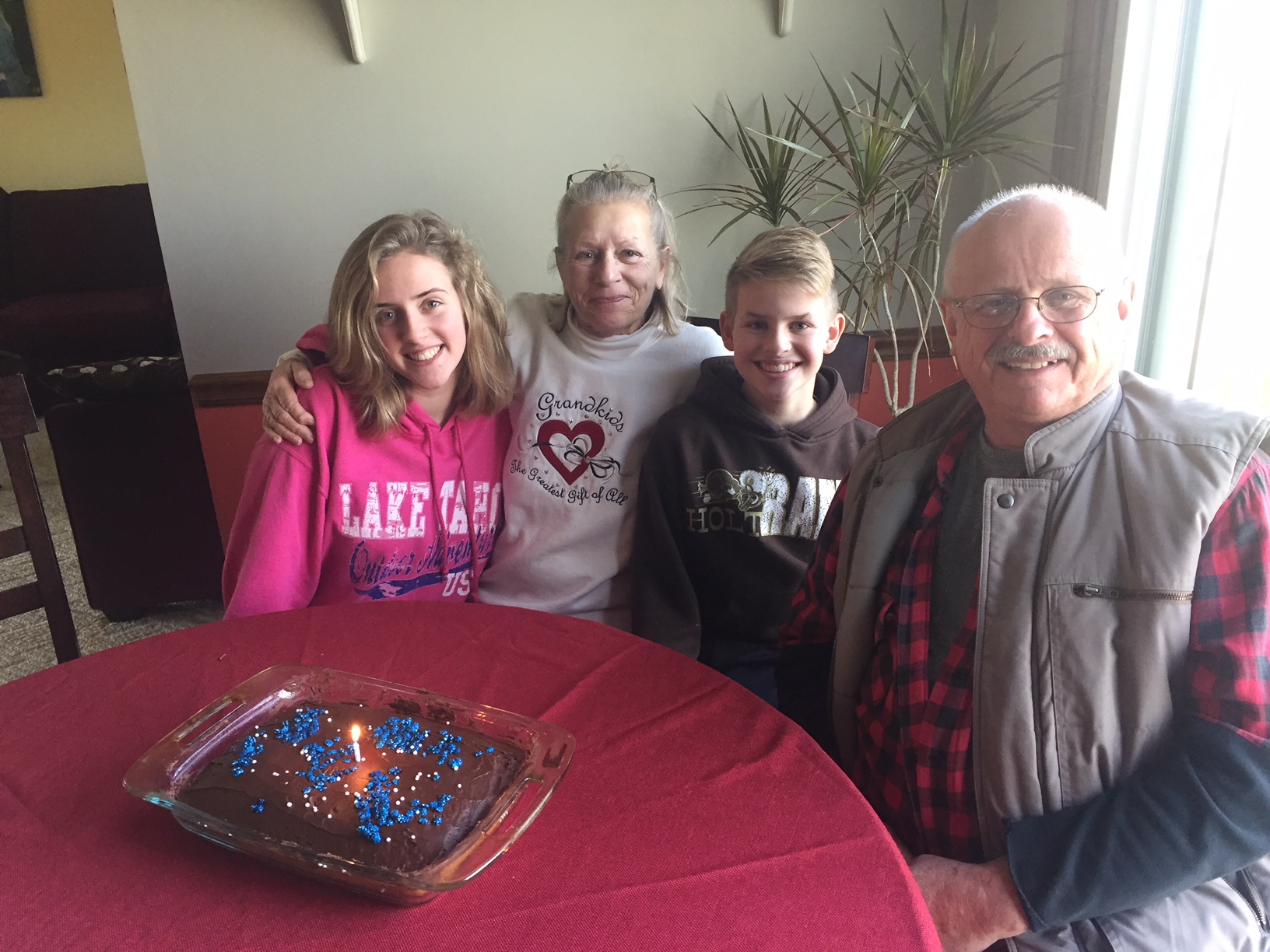
Looking back, there are things that might have predicted a change. Cousins visited in June who haven’t been here in years. Her youngest child and granddaughter moved in and shared the garden work for most of July and August. She made a ridiculously huge batch of my favorite Jalapeno Jelly in September. In October, my wife took an unlikely day trip with just her parents to picnic at an Amish farm, where they bought cheese. When she came for her birthday lunch on December 4th, she looked more alive than usual and stayed for two hours after the meal. This was especially uncharacteristic, as she typically ate, asked to do dishes for us, then scurried home intent on “letting you get on with your day.” Our family trip to see Santa at the Peacock Road Tree Farm had to be moved from December 22 to November 23rd. She died on December 19th. Looking back, we might ask, “did she know?”, or assume these all happened to prepare us. Looking back, I have faith and gratitude in what matters more: all these things happened.
Death is strange to watch. I’ve seen it in various stages, from the initial diagnoses of a terminal disease, to the the quiet end of an infant, to the unexpected loss of trauma, to the natural passage of old age; each time I have seen snippets of death in its wonder, horror, certainty, and uncertainty, but this was my first time experiencing the entire passage from life with someone I dearly loved.
We received a text message on Sunday morning, December 10th, that “Grandma finally decided to go to urgent care”, from my wife’s father after she had been coughing for a few days. The way she actually phrased it to him was, “Do you still want to go to urgent care?”, which was her way of saying, “I think I need help.”
Throughout the day, we received text updates, sometimes from Grandma and sometimes from Grandpa, and sometimes from both but I don’t think they knew they were both updating us. The urgent care sent her to the ER, as expected for breathing difficulty. She texted me updates on the long wait. They ran EKGs and checked her out, then she waited more. Grandpa went home for the night, while she waited for tests to be done. Grandma told Tina not to come see her, that we’d talk in the morning when they sent her home. The doctors told her she may have fluid around her heart and wanted to do a CT scan, but since she was allergic to the iodine contrast, the prep process was longer. I joked with her that they might find the fluid to be Budweiser. Grandma loved her beer every night. She joked with me that they “must be making the machine” and “I’m gonna die of old age before they get through with the tests”. The last thing I texted her was, “I hope you pass…the tests, not wind!” Looking back, Grandma always laughed at fart jokes.
Tina opened the shower door at 6:15am and told me they intubated Grandma and she was in ICU. Okay, I thought. Maybe it was a worse pneumonia than expected, sometimes they need to relieve the effort on the body while they treat something. We’ll just not tell the kids and get them to school, then go see what’s going on. So we did. Looking back, I’m grateful that Tina and I have the medical backgrounds we do so neither of us freaked out.
When we got there, Grandpa was in the room and Grandma was on a ventilator. The tour of interns and pulmonologist came in and explained that Grandma had a “major cardiac event” around 3:3o in the morning, which led to her being moved here. He mentioned liver enzymes were raised, kidneys were not functioning properly, her sugar was over 600, and her cardiac output was less than 50% of its potential. Even 20 years removed from medical work, I remembered none of these were indicators of a life that could continue. Even being able to translate some of the scientific jargon, your brain is never prepared to interpret phrases like, “end-of-life decisions”, “gather your family”, or “it is time to call in any important relatives”. Those are sound bites I recall, as I breathed deeply and the machine breathed rhythmically for Grandma.
Monday was long. We sat by her bed, held her hand, and kept our conversations and our tears quiet. We stepped into the hall to wonder aloud together, what can she hear, what is she aware of, how do you wait for something like this to play out. We picked the kids up from school as a family, and explained to them what we now knew was going on. We described what they would see is far from the active Grandma they helped in the garden or from her birthday just last week. We cried as a family in the drug store parking lot across the street from the hospital. It was snowing. Both kids chose not to see Grandma sick, but wanted to see Grandpa in the waiting room. While they held onto Grandpa, Tina and I went to her side and worked with lotion to remove her wedding bands from her swelling fingers. Grandma has two matching bands and two beautiful daughters, they represented to me. Separating these from her loving hand was one of the emotionally harder symbols of finality to endure. The adults all came to her room once more, where Grandpa told me Grandma wouldn’t want random preachers showing up, and that if someone was to pray over her, he’d like it to be me. I quietly took her hand, kissed her forehead, and prayed that God welcome her to see her parents. Then I told her it was okay to go. Looking back, just like when our kids came into the world, when a loved one is leaving, there are no manuals for how it’s supposed to go. You take some of the things you’ve learned, approximate them the best you can, and follow your heart to support those you love more than life itself.
Tuesday morning we encouraged the kids to go back to school for routine so we could either deal with hospice or funeral planning. The tour of doctors came in and told us they were surprised that her labs had improved somewhat, her kidneys were putting out fluid, her lungs were a little drier. Our conversations turned a little louder around her bed, with more laughs, and more talking to Grandma while we played with her hair. I played Folsom Prison on my phone and her leg tapped. We asked her yes/no questions and she squeezed our fingers or lifted her hands. She made faint eye contact between naps. Looking back, I think our prayers for peace turned to prayers of hope.
Wednesday and Thursday brought that hope. The doctors continued to be conservative about the damage her heart had sustained, but continued that all signs are looking better. I remember hearing “some people live many more years with limited heart performance..they won’t run marathons, but it is possible.” The medications that were keeping her alive were slowly being reduced, to see just how much her body could do on its own. The medications sedating her were reduced almost entirely and even though she still breathed on a vent, she responded more meaningfully to us. Thursday was a snow day from school, and we offered the kids to see her again, but both wanted to wait until she was not on a breathing tube. We spent most of the day interacting with Grandma where she would acknowledge she needed a cool rag or lip balm. We explained to Grandma what had happened and why she was there, and she nodded understanding. The nurses attempted to remove the breathing tube, but Grandma was too anxious to calmly breath on her own. We went home early that day and as we turned the corner into our sub, I told Tina that whatever happens at this point, I felt like it was a blessing that we were able to connect with Grandma. Looking back, in my heart we had turned a corner.
About 5:30 Thursday night, I was decorating cookies with the kids and Tina had gone to work for a little bit. Grandpa texted that something happened and they had to shock Grandma twice. He was headed back to the hospital. By the time we all got there, all medications had been taken back to full dosage and Grandma looked like she did on Monday morning. The doctors were not around and the nurses could only state the facts of what had happened, without speculating on why or what outcomes we might expect. It would seem obvious that two cardioversions to a wounded heart muscle couldn’t be promising. We stayed with her a couple hours, then returned home to get the kids back into routine.
On Friday, I returned to school with the kids while Tina spent the day at the hospital. She texted me frequently and around 12:30, told me that per the doctor’s discussion we should probably gather to make “life-ending decisions” by Monday morning. When we arrived at 8:30 Saturday morning, we were told that things seemed surprisingly better and the medical team wanted to attempt removing the breathing tube again, this time with a different anxiety medication. By 11:30 that morning, we watched as they pulled that long tube of life from her lungs. Grandma coughed and sputtered a little bit then started mouthing things to us. By 12:30, the nurses offered whatever she wanted to eat, which was vanilla ice cream. And she ate. By the time we were leaving at 2:30, Grandma was sitting up and holding a cup of water, using a straw. She told us to be safe when we left. As it was happening, I remember thinking it was improvement. Looking back, I think the medical team must have known that these small signs of life were about the most she would ever do again. I believe they provided us with the most authentic chance to say goodbye that we didn’t know we would need.
Late Saturday night, my sister-in-law updated us that Grandma was coughing a lot and breathing really hard. We assumed this was from a week in the bed with the original respiratory condition continuing. We came back Sunday morning to find Grandma hyperventilating on a face mask that was forcing oxygen into her. The medical team who had taken us through the week of highs and lows, returned with a much more glum disposition. Dr. Huhta, who had been seeing us daily since her first day, told us that she was unable to continue breathing like this and would need to be intubated again. He went on to say that her breathing and heart were no longer working as a team due to the damaged heart muscle. Grandma looked on, pulling for air and nodding, as we had this conversation. Dr. Huhta explained that if she were to be intubated again, it would not come out again and she would not leave a bed. Her heart was too weak to support life.
Grandma spent years telling us she didn’t want to live on machines. We knew these were her wishes, which is exactly why she was mad briefly when they first pulled the tube out. She didn’t realize, nor did we, that in her panic of not breathing before her heart attack, she actually asked the nurse to help her breath which is why they put her on life support to begin with. Looking back, that panic was the only thing that allowed us a week of ups and downs, scares and comforts, and time to connect with Grandma so that the goodbye wasn’t so sudden.
Tina and I repeated the news to Grandma. I distinctly remember, Tina in all her strength looking into her mom’s eyes and holding her hand hear her chest, stating, “Mom, they have to put the breathing tube in to keep you alive. If they put it in, it will never come out. You can’t go to the garden with the tube. You can’t can your foods with the tube. You can’t bake with the grandkids on a tube. Do you want that?” Grandma continued nodding her head, which shocked us both. A doctor said, “Sue, if we put this tube back in you are still very sick. Most people…” I cut him off because I really didn’t want to hear a decision on our mom’s life framed on what most people do. Tina and I held her hands and I said, “Grandma, you are going to die. Your heart cannot keep you alive and all the things Tina said are true. Do you understand that you are dying?” Grandma continued to nod. We explained that they would help her feel no pain and we would all be together. Grandma nodded. Looking back, I truly believe that Grandma had been hyperventilating for so long that she was nodding to everything due to the lack of oxygen.
The doctors predicted she would stop breathing anywhere from 4 hours to 12 hours. We settled in for our final goodbye. Within an hour, they had all machines removed and most of her IVs stopped, except for morphine which allowed her to breath gently. As she got regular oxygen, Grandma returned to meaningful interactions answering our questions with single words and sipping water and ice chips from a straw.
We went home and got the kids, telling them the current status and that Grandma didn’t have tubes anymore and it was time to say goodbye. McKenna walked into the room and instantly took up Grandma’s hand, holding it like a pro and facing her own sadness with a maturity beyond her years. She talked to Grandma conversationally and Grandma looked confused that McKenna came alone. Shortly after, Grandpa walked in holding Brogan up. Brogan has never been good with medical devices or environments. He slowly approached the bed, hugging her around the belly, saying, ” I love you, Grandma” before melting into a chair. He held her hand for only a minute more, then asked to leave. McKenna stayed by Grandma’s side all day, tending to her needs, loving on her, transcending her own sadness. Grandma gazed upon each of us, winking occasionally, squeezing a hand, listening as we tried to fill the room with conversation other than the inevitable. Looking back, each of us have our own way of dealing with life and death.
Jimmy Buffett wrote, “There’s something about a Sunday, it’s a most peculiar gray.” Throughout that Sunday, one week after Grandma agreed that Grandpa could go to urgent care, we each shared individual and group moments with Grandma in her bed in Room 19 of the ICU. My larger-than-life brother-in-law, who doesn’t cry, wept with me and Grandpa as we were told how important we had been to the couple, since they didn’t have one son, but were blessed with two great ones through their daughters. Tina and her sister recalled family road trips and Grandma burning bread. Grandpa affectionately called her “kiddo” many times that day, as he stroked her hair. Then she told us we should get going. I assumed it’s because she knew she was ready to get going.
Final goodbyes are personal and can’t always be remembered as tenderly as they are experienced. Sometimes they are actually more awkward than we’d like to recall them. I do remember when we all decided to go, Grandma sat up in the bed like there was a snake in it with enough energy to give all seven of us hugs with both arms. With my hug, I remember her clearly whispering, “I love you so much. Drive safe.” I can only assume that each of the family was blessed with the same. Then we walked out of the room without looking back. In the hallway, Grandpa stopped to ask the nurse not to call between 5pm and 7am when it happens and we would call in the morning to finish arrangements. As a family, we cried in the kitchen in one big mass of hug when we finally got home. Looking back, the only things you really should rely on in times of sorrow or celebration and your faith and your family.
We woke up, obviously blue the next morning and Grandpa texted us that she was still alive, so Tina and I drove back to the hospital for the second Monday in a row, unsure of how to feel or what to do as we had said our goodbyes. I could have fallen on the floor when I pushed the curtain back and saw Grandma sitting there with a cup in her hand and the straw in her mouth, drinking water. All at once, my mind raced that perhaps they were wrong, and we were wrong, about all this weak heart stuff. She was off all supports except morphine and she was drinking water in front of me. I looked at her monitors and she seemed to be getting enough oxygen, her heart rhythm was normal, she was drinking water for God’s sake!
Over the next few hours, her breathing changed while we watched. She would doze in and out of naps. I tried to distract myself and Grandpa by describing what I remembered about heart monitors and signs of life, or death. About 11:30 that morning, Tina and Tracie had gone to get food. I played one of my songs for Grandma on my phone while Grandpa and I held her hands. Suddenly, Grandma reached out in front of her towards the air. Then she looked at me and said, “Give Tina my blue ring….the lindy star.” I repeated everything she whispered so Grandpa could hear it. He said he knew which ring she meant and would be sure to do that. I asked her if there was anything else she needed us to know, or if there was anything to tell Tracie. “Tracie doesn’t like jewelry,” she said confused-like, because she would never make me feel like a moron on purpose! “She can have my guns.” I assured her I would tell the girls. Looking back, this is when I knew that she was accepting of death and it was eminent.
Throughout that Monday, Grandma would recall several other small things. “Give the money from my purse to the kids.” “The spare car keys are in my purse.” To the end, she was concerned about making sure all things were taken care of, as a mom always does. While no one wishes someone away, and you can’t rush death, we were all confused at what she might need. We had all given her explicit permission. I had prayed with her twice. The grandkids…all but one, had come to see her. Tracie decided then that maybe Grandma was waiting for Sydney, the youngest grandchild.
With special permission, the hospital allowed Sydney to the ICU floor to see Grandma. She was silly at first, as all five-year olds are, especially when they are nervous. She recognized her own drawings that were posted on the walls of the hospital room. She was hesitant to touch Grandma at first, even though Grandma made eye contact and waved her hand a little. McKenna, who is the kid-whisperer, eventually convinced Sydney into holding hands with Grandma. We talked a little and tried to fill the air with “normal” conversation to keep Syd from being scared. Looking back, there’s the whole manual thing again…there isn’t one, so just do what comes naturally when parenting. Allow yourself to feel. Allow your kids to see you feel. Allow them to feel. And share it.
There’s a song from Tina’s childhood, and mine, that bonded us early in our relationship: John Denver’s “Country Roads”. She and her family would sing this on car rides through the U.P. I learned it from a German choir, of all places, then sang it as I went out west as a teen. We all sang it together over the past twenty-years at bonfires and Grandma’s request. When Tina asked me to sing to Grandma, it’s the first song that came to mind. I can clearly see Grandma’s silky hair and forehead I was stroking. Grandpa stood at the foot of her bed, holding her toes between his thumb and fingers. Tina and McKenna sat opposite me, holding her hand. Tracie held Sydney at my left side, and we all sang, “Almost heaven, West Virginia…” Every voice broke after those four words and Grandpa turned away sobbing. The choir of girls and I made it through the rest of the verse only. Grandma’s eyes were closed. We all gave hugs, but this time she didn’t spring up. Grandma’s eyes slowly opened and closed as we each kissed her head and told her we were leaving. Looking back, I wish that was the final goodbye because there is not a more beautiful or fitting scene in my mind’s memory of Grandma.
Tina and I were the last to leave the room. Tina had noticed that Grandma spent the past two days, looking in the hallway at feet when people came in, wondering if she was waiting for someone or something. Not knowing what else a dying person may need, all I could think was God. I remembered Grandpa asking me to pray earlier in the week and wondered if she was waiting for more assurance. When I kissed her head, I thanked her for always asking me to pray for the family at our meals. This was enough to show me that God was in her heart and waiting for her, regardless of who prays over her. I recited Romans 14 “Living. Live unto the Lord. Dying. Die unto the Lord. But living or dying, you are the Lord’s.”
Grandpa left without saying goodbye that day. He texted later that he had to be done and we all understood why. The first of our repeated heartaches for him began that evening. We left the nurses the same expectation, that we’d call after 7am to learn what we needed to do next. That night, I called Grandma’s cousin Bob and cried with him on the phone. He had been working to help Grandpa with the last job of his 40-year business, before retiring, and had not been able to get to town to see his cousin. I promised him that if by some strange twist, she was still breathing the next morning, we would tell him.
At 7am on Tuesday morning, I was nothing short of shocked when the hospital told us Grandma was alive and breathing. No one did this, but talk about playing with emotions. Was she really not ready? Does it just take the body a long time? Was there unfinished business? I texted Bob on our way to the hospital and Grandpa had already called him. We all met in the waiting room. Grandpa and Tina did not want to return and see Grandma for another goodbye after the two, hard days. While some feel my faith is strong, I felt a need to see for myself how Grandma was doing so that I could be assured if she needed us by her or not. Tracie and I went to see her and all medical supports were now removed. I don’t know when the soul actually leaves a body, but it wouldn’t surprise me if she were at that point looking at us from somewhere other than the bed. Tracie and I had no tears, just peace.
Bob replaced Tracie and I’ll never forget him calling her the nickname he used for 60-plus years with her. Bob took her hand and said, “Hey Sues. Sues, I love you.” Grandma’s eyelids twitched one. Her brow twitched a couple times. Her upper lip and nose slightly snarled, like Elvis. Otherwise, she lay peacefully. Tina asked Bob and I to sing, as we had so many times for Grandma. The obvious song would have been our duet of “Who Will Sing for Me”, a bouncy bluegrass number he and I had played for years about who will sing on your deathbed. Isn’t bluegrass just that way? A banjo makes everything sound a little happier. But we didn’t have a banjo, and we weren’t feeling too happy. We just had each other, and Grandma “Sues”, so we sang an acapella verse of Amazing Grace. Bob and I held each other in the hallway, then walked out to the family and we all departed the all-too-familiar hospital about 11:30.
Tina and I stopped at a scrubby diner for lunch, then went of all places to a car dealership to distract ourselves and see how much our car was worth. Grandpa texted us at 12:45 that the hospital called and Grandma was gone. We walked through the parking lot mindlessly, holding hands, not talking. Looking back, God gives us each what we need when we need it. Our job isn’t to make new sense of the things that happen, but to be grateful because God knows they needed to happen, just that way.